Land feasibility & highest-and-best-use underwriting

The feasibility study that shows its working.

A consultant-led site study takes four to eight weeks and arrives as a PDF you cannot interrogate. PlanIQ produces the same rigour in an afternoon — cadastral areas measured by a real spatial engine, twenty-five candidate uses screened through four gates, a period cash-flow residual, and a risk distribution instead of a single number. Every figure traces back to the evidence it came from.

Live demo environment · PostGIS spatial engine · Multi-jurisdiction rule packs
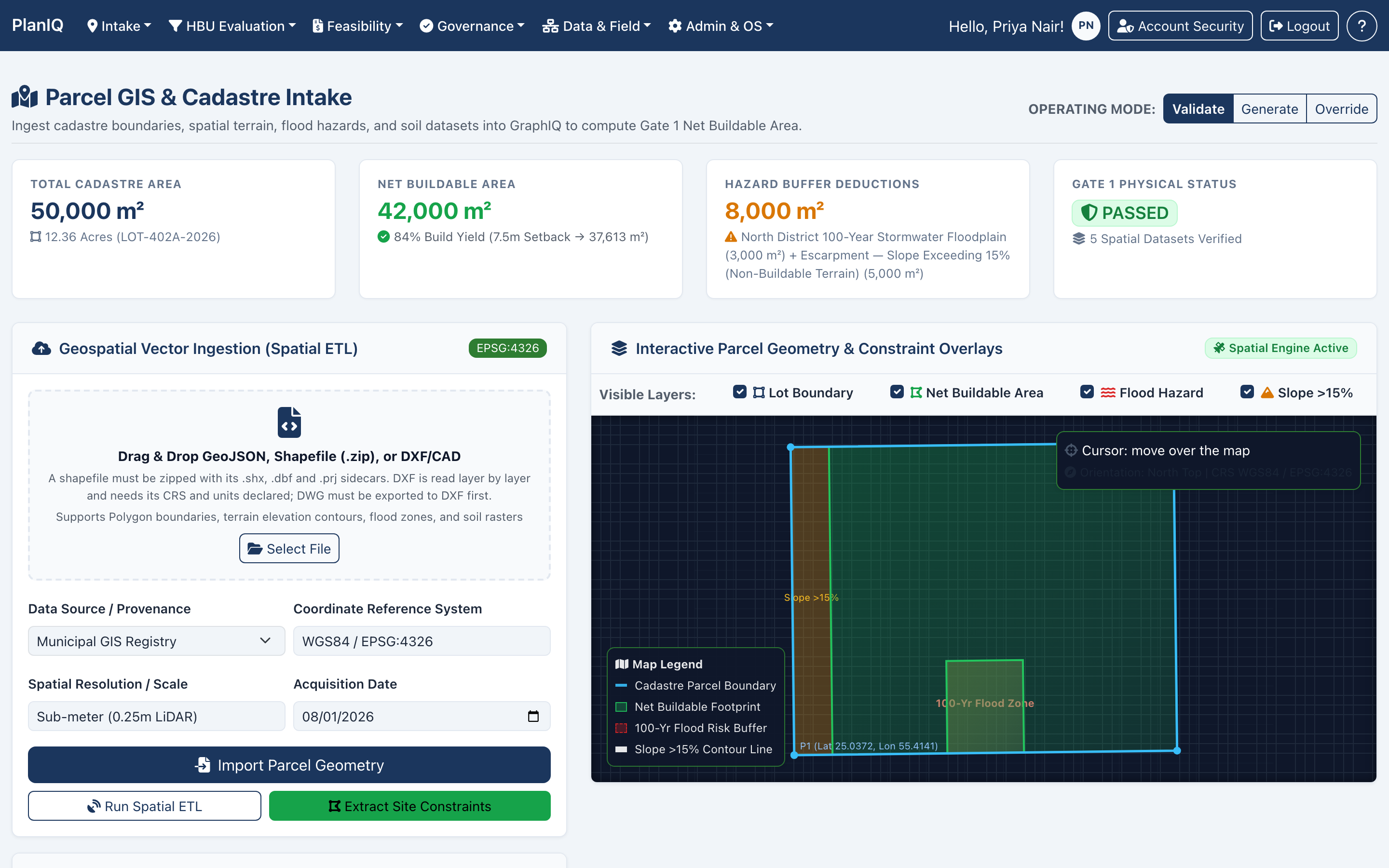
PlanIQ parcel GIS and cadastre intake showing net buildable area computed from measured geometry
42,000 m² net buildable
Measured, not asserted
σ
P10 / P50 / P90 IRR
10,000-iteration Monte Carlo
Defensible by construction Effective-dated jurisdiction rule packs Content-hashed, immutable verdicts Append-only audit trail WebAuthn / FIDO2 & TOTP MFA Local projected CRS, per jurisdiction Deny-by-default tenant isolation
The throughput problem

A consultant gives you one answer. A spreadsheet gives you no defence. PlanIQ gives you both.

Nobody doubts the quality of a good feasibility consultant — the problem is throughput and repeatability. A study costs weeks and a fee, so you commission one per site, on the sites you already like. The scheme you did not test, the use you did not consider and the downside you did not model never appear. Meanwhile the in-house workbook that fills the gap has no provenance, no version history and no way to show an investment committee why a number is what it is. PlanIQ is not a replacement for judgement — it is the machine that lets judgement be applied to every site, every use and every downside, with the working attached.

4 gates
Physical → legal → financial → productivity, each with a recorded reason for every rejection
25 uses
Every candidate development use screened against the site, not the two you had in mind
10,000 runs
Monte Carlo with a logged seed — the same inputs reproduce the same distribution
Afternoon, not a quarter
Screen a site, model the scheme and stress it before the next investment committee
One platform, land to committee paper

Everything between a title deed and a funding decision

Not a GIS viewer with a spreadsheet bolted on. Every module is shaped around how land actually gets underwritten.

Gate 1 — physical feasibility, measured

Cadastral boundaries, flood, slope, soil and road networks resolve to a net buildable footprint using real geometry operations — hazards that overlap are dissolved and deducted once, not double-counted. Areas are computed in the local projected CRS, never in degrees.

Four-gate highest-and-best-use

Every candidate use is screened against the site's own measured constraints, then its zoning, then its economics, then ranked by productivity. Each rejection carries a coded reason and the threshold that produced it.

Pro-forma & residual land value

A period-by-period cash flow with escrow release, debt drawdown capped at the binding constraint, interest capitalised to practical completion and expensed after. The residual is a stated formulation, not a rule of thumb — and it exports to CSV.

Monte Carlo risk frontier

Price, cost, absorption and interest sampled across thousands of iterations to produce P10/P50/P90 returns and a hurdle-clearing probability — then an efficient frontier across scheme configurations, tested for Pareto dominance rather than labelled by hand.

Use-mix & density optimiser

Blend the surviving uses into phased configurations bounded by real catchment demand, with a cap status that refuses to propose more of a use than the trade area can absorb.

Validate mode — vision versus benchmark

Measure a sponsor's proposed scheme against the optimiser's own benchmark, parameter by parameter, with a fragility rating and a written mitigation for each gap. It answers "why is our scheme worth less than it could be" in a table.

Jurisdiction rule packs

Planning regimes are versioned and effective-dated, with forward schedules for rules that have been published but not yet commenced. A pinned verdict always names the exact regime it was decided under.

Evidence feeds & entity resolution

Public registry spine, operational exhaust, municipal master plans and commissioned field research ingest continuously. The same unit listed on four portals collapses into one canonical record, with confidence that rises as independent sources agree.

Deliverables studio

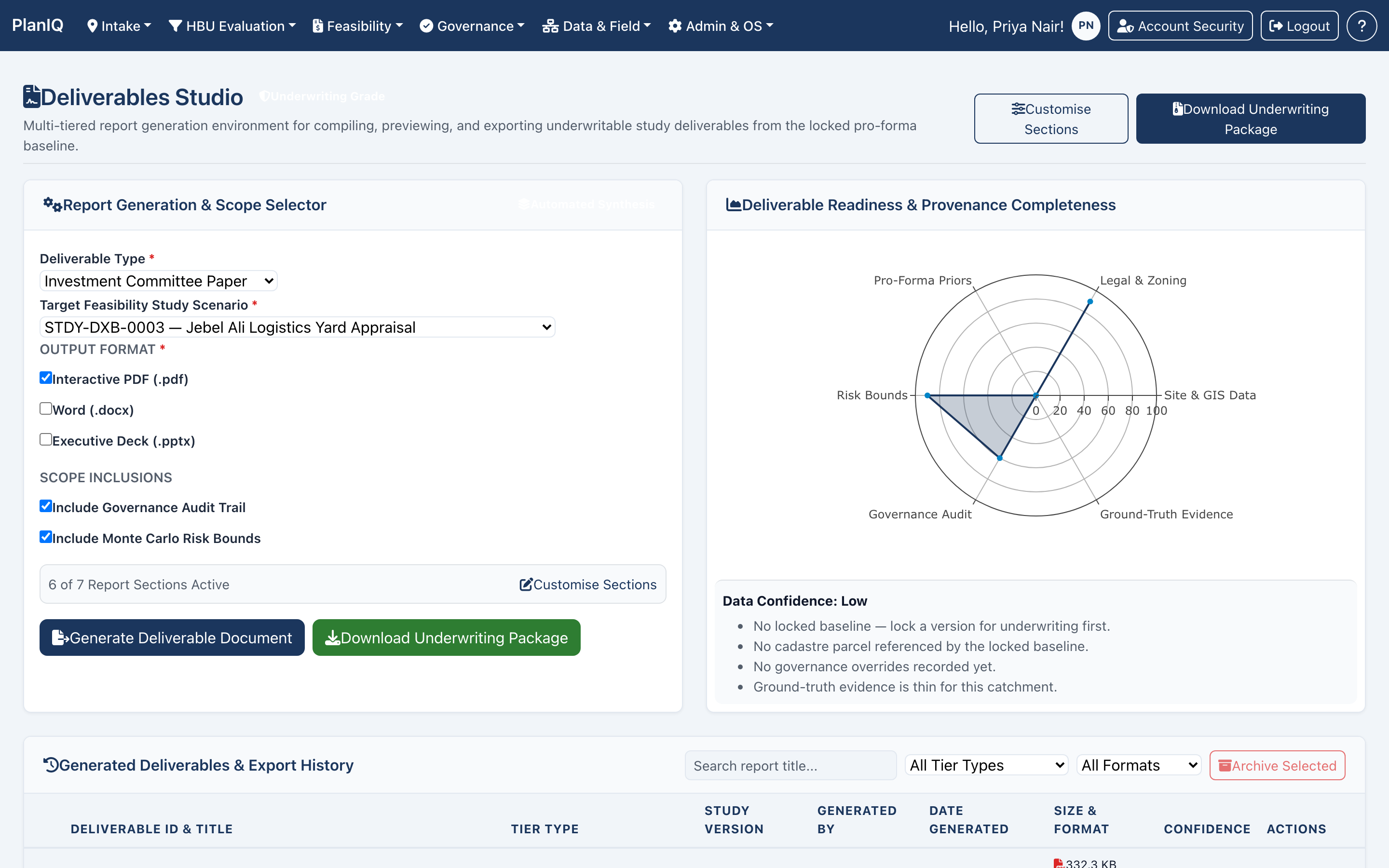
Screening memo, investment-committee paper, lender study or master-developer brief — compiled from the pinned baseline rather than retyped, stamped with the study version and carrying a confidence level that cannot be suppressed.

See it in action

Real screens from a real, running product

Not mockups. Every screen below is live in the PlanIQ demo environment today.

Highest & best use

Twenty-five uses in, a ranked shortlist out — with the reasons

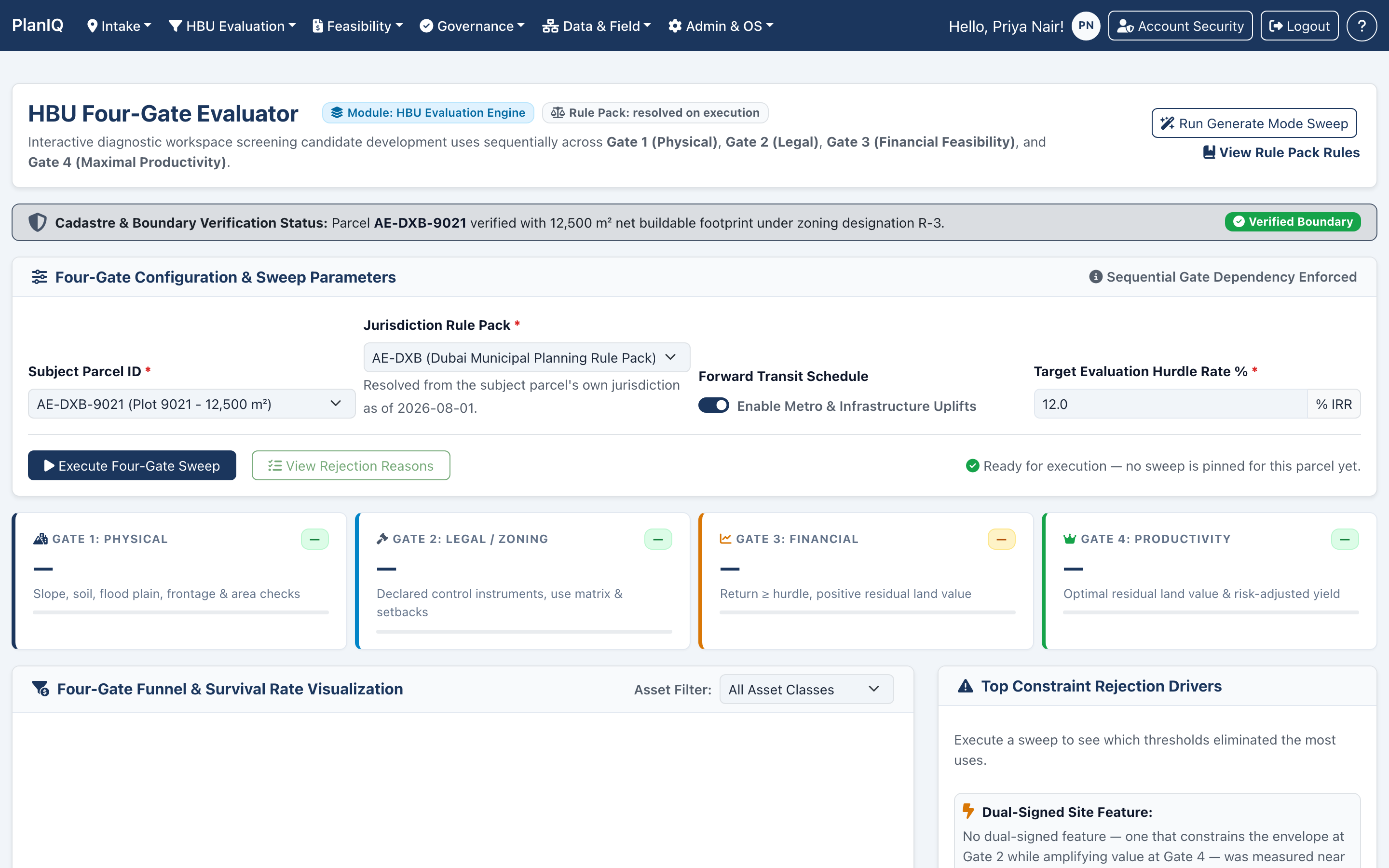
The funnel is not decorative. Each candidate use meets the site's measured net buildable area, its slope, its soil bearing, its flood exposure and its road frontage before it is allowed to meet the zoning — and the zoning before it is allowed to meet the money.

  • Coded rejection reason and threshold on every eliminated use
  • Top constraint drivers ranked across the whole sweep
  • Survivors ranked by residual land value per m²
PlanIQ four-gate HBU evaluator showing the screening funnel and rejection drivers
Financial feasibility

A residual you can defend line by line

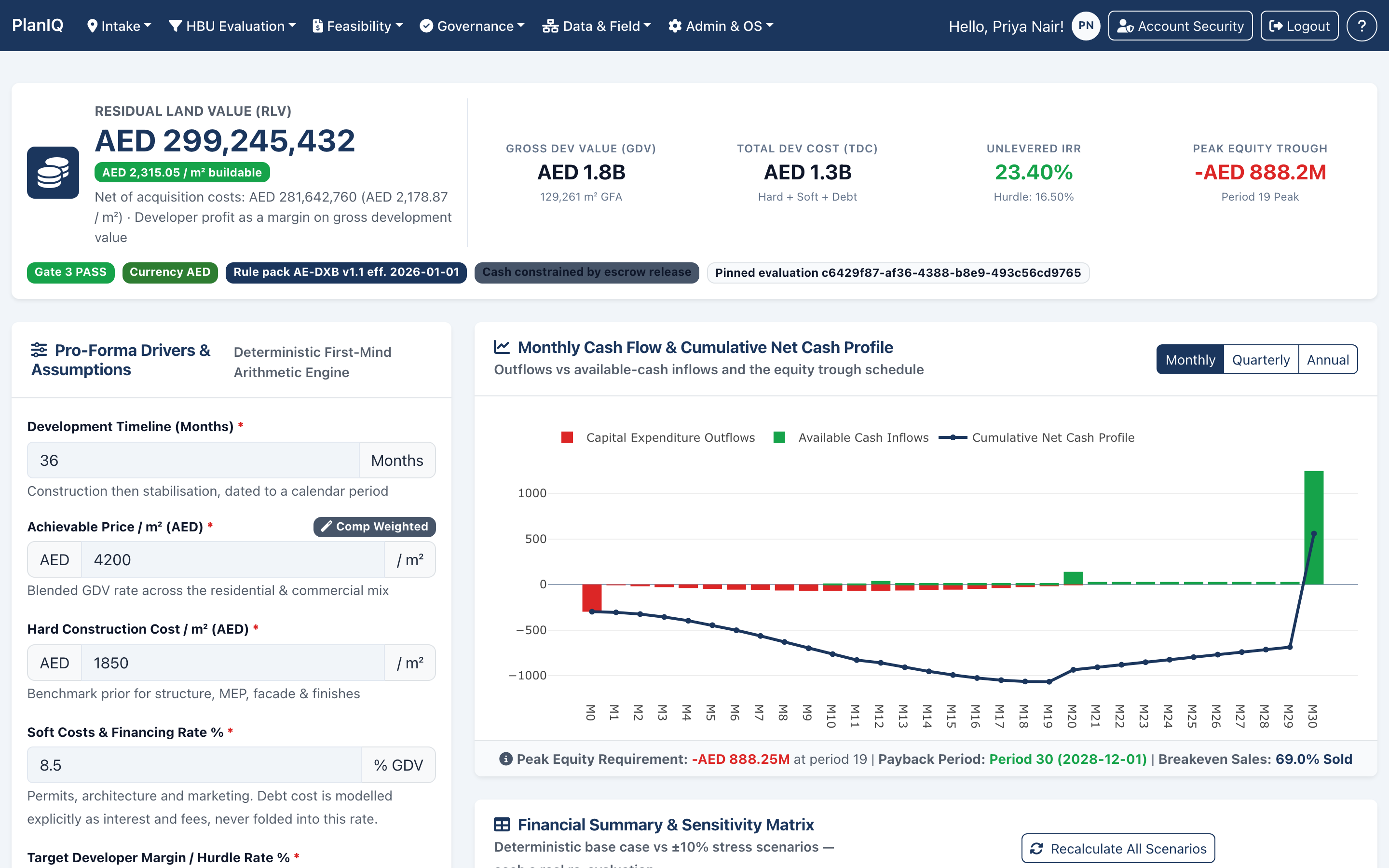
Gross development value, total development cost, net present value and the residual land value — each derived from a period cash flow you can open, read and export. Escrow release, debt drawdown, capitalised interest and peak equity are modelled, not assumed.

  • Full period cash-flow grid, exportable to CSV or Excel
  • Sensitivity columns are real re-evaluations, not the base case × a factor
  • IRR withheld — not faked — when the cash-flow series admits several
PlanIQ pro-forma and residual land value modeller with period cash flow
Risk

A distribution, not a number — and a frontier, not a list

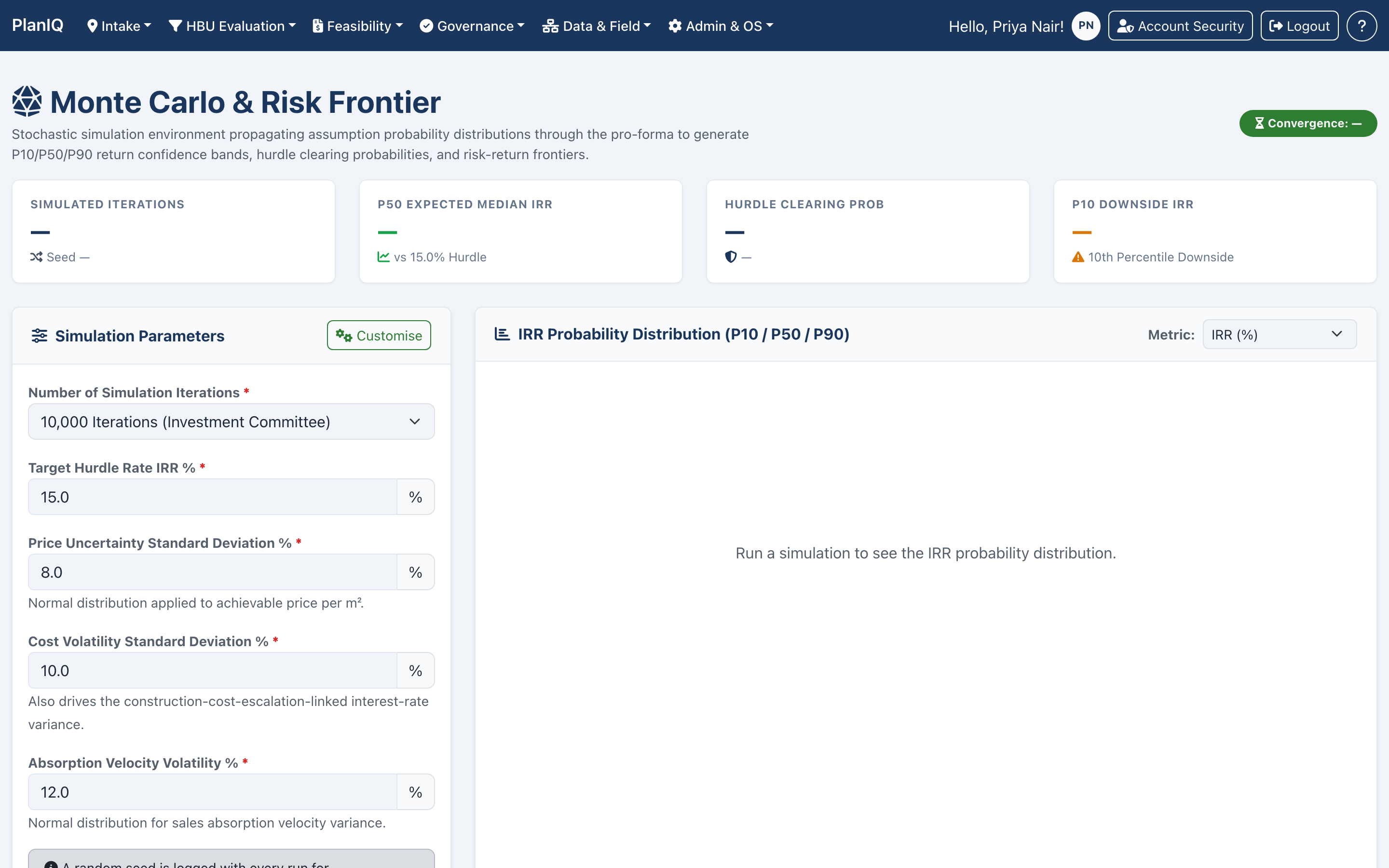
A single IRR is a guess wearing a suit. PlanIQ samples price, cost, absorption and interest across thousands of iterations to report P10, P50 and P90 alongside the probability the scheme clears its hurdle at all. Every scheme configuration is then tested for Pareto dominance: a configuration sits on the efficient frontier only if nothing else offers both a higher expected return and lower volatility.

  • Logged random seed — a run is reproducible, not re-rolled
  • Convergence and discarded-iteration counts reported, not hidden
  • High-fragility configurations flagged where the downside turns negative
PlanIQ Monte Carlo risk frontier with scheme portfolio and clearing probabilities
Evidence

Every input knows where it came from

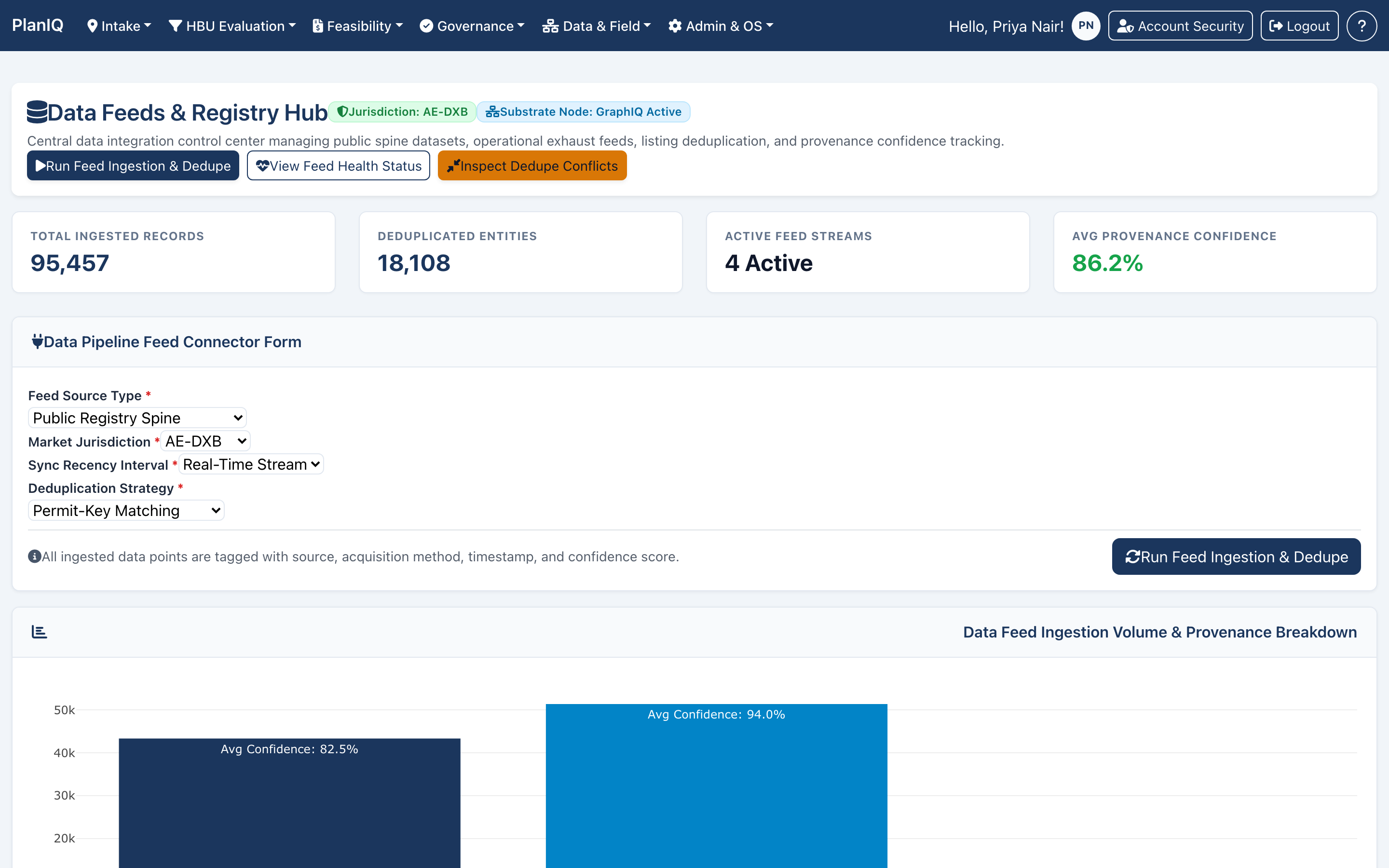
Registry spine, operational exhaust, municipal master plans and field research arrive through a feed registry that tags each record with its source, how it was acquired, when it was valid and how far it is trusted — and marks whether a value is evidence-derived or merely asserted.

  • Permit-keyed deduplication across competing portals
  • Planned infrastructure carries a realisation probability, not a promise
  • Ask-price history and eventual ask-versus-achieved discount
PlanIQ data feeds and registry hub showing source provenance and deduplication
The compounding asset

It is worth more in year three than on the day you install it

Most underwriting tools are static: they compute what you tell them and forget. PlanIQ closes the loop. Two flywheels turn — one on your own delivered projects, one on the open market — and both feed the same place: how widely the model is willing to bet.

Flywheel one · your project data

The model learns which of your forecasts were wrong, and by how much

When a study's baseline is locked for underwriting, PlanIQ writes an immutable prediction snapshot — the input assumptions, the model parameters, the confidence interval, and the predicted gross development value, IRR, absorption velocity and residual. It is never edited; it is the record of what you believed, and when.

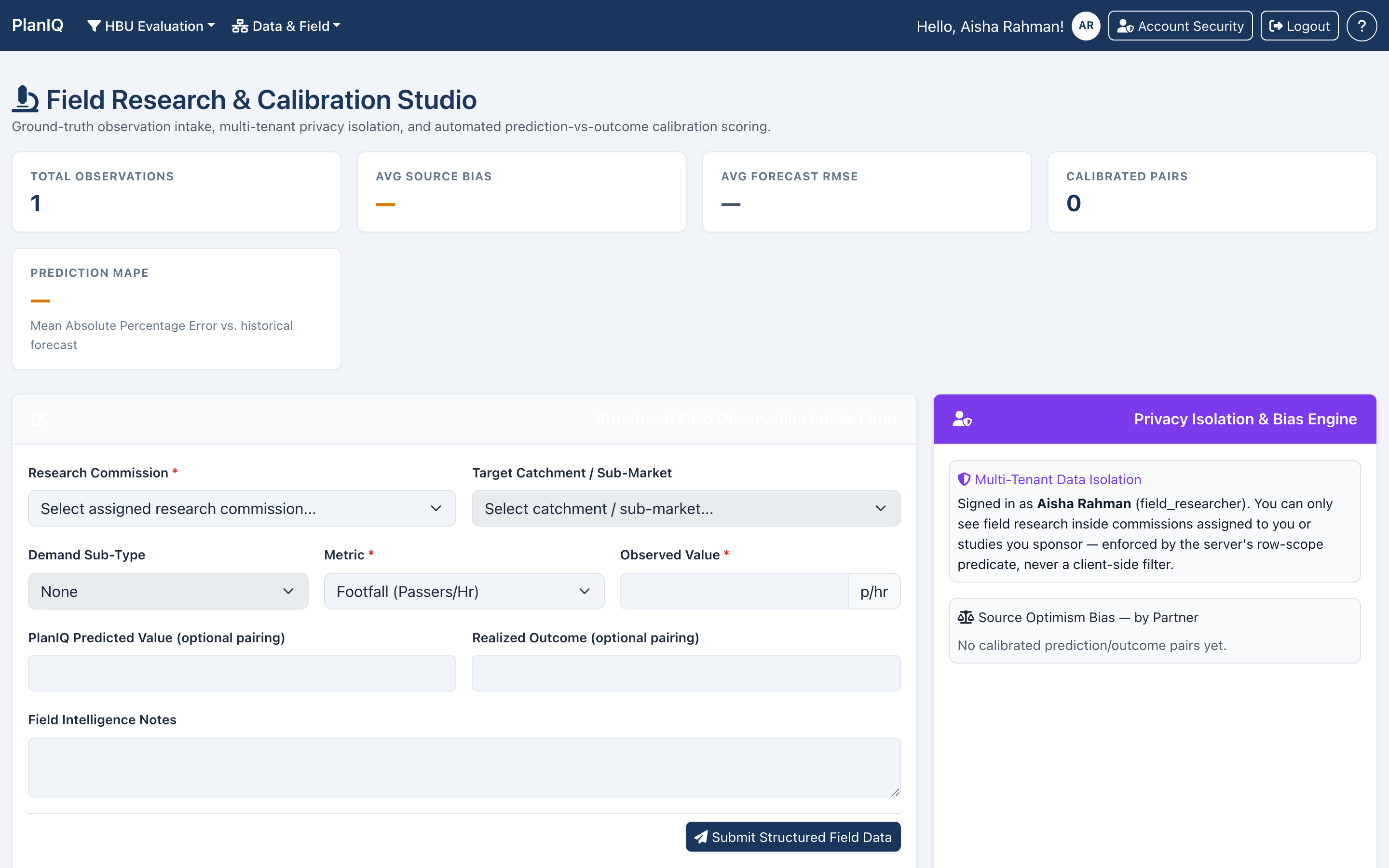
As those projects complete, the realised outcomes are matched back against the prediction. The difference becomes a forecast error in basis points, and from that PlanIQ builds a scorecard per source: the signed bias (is this source systematically optimistic or pessimistic), the RMSE, a Brier-style accuracy score, and the mean absolute percentage error.

Then it acts on it. That MAPE feeds forward into the next Monte Carlo run as a variance multiplier — a source with perfect calibration widens nothing, and a source that has historically been fifty per cent out doubles the spread of every distribution it informs. A forecaster with a track record of optimism does not merely get a footnote in the file: the model measurably stops trusting them as tightly, and the investment committee can see exactly why the bands got wider.

  • Prediction snapshots are insert-only — the record cannot be revised after the fact
  • Historical deal archives import as calibrated pairs, so priors exist from day one
  • Commissioned field observations pair with their forecast and score it
PlanIQ field research and calibration studio showing prediction-versus-realised accuracy scoring
Flywheel two · open-source intelligence

Public evidence compounds into confidence

Alongside your own history, PlanIQ ingests the open market continuously across four distinct layers — the public registry spine (transactions and cadastre), operational exhaust (broker and MLS activity), the municipal master plan (permits and planned infrastructure) and commissioned field research. Each layer carries its own trust weighting; none is treated as ground truth simply because it arrived.

The value is not the volume, it is the agreement. When the same underlying unit surfaces on four competing portals, permit-keyed entity resolution collapses it into a single canonical record and raises its resolution confidence with each independent re-delivery that agrees — because four sources concurring is evidence, and the same source repeating itself is not.

That evidence depth then sets the width of the risk bands directly. A scheme priced against ninety corroborated comparables is modelled tighter than one priced against twelve, and the widening factor is recorded on the run so an underwriter can see the difference rather than infer it. Planned infrastructure is handled with the same honesty: a metro extension is real registry data about something that has not been built, so it carries a realisation probability rather than a promise.

  • Source, acquisition method, as-of date and confidence on every node and edge
  • Evidence-derived and merely-asserted values are distinguished, never blended silently
  • Live inventory correlated against handover stage to separate current from upcoming supply
PlanIQ deliverables studio compiling an investment committee paper from the pinned baseline
Both flywheels arrive at the same lever. Whether the signal comes from a project you delivered or a market you observed, it resolves to one honest question — how confident should this number be? PlanIQ answers it by widening or tightening the distribution, and by writing down why. Nothing is silently reweighted behind the glass.
Watch the demos

See PlanIQ in action

Two walkthroughs — one from the analyst's seat, one across the whole underwriting and governance chain.

Analyst walkthrough

Site to residual in one pass

Ingest a parcel, measure the buildable footprint, screen every candidate use through the four gates, and land on a defensible residual land value.

Platform walkthrough

Risk, governance and the committee paper

Stress the scheme across thousands of iterations, read the efficient frontier, lock the baseline and compile the investment-committee deliverable.

Against how it is done today

PlanIQ versus the manual process

There is no like-for-like product to line up against, so this compares PlanIQ to what land actually gets underwritten with today: a commissioned consultant study, or the workbook someone built in-house.

Capability PlanIQ Consultant-led study In-house spreadsheet
Turnaround for a new site ●  Same day ✕  4–8 weeks ◑  Days, if the model fits
Cost of testing one more scheme ●  Marginal ✕  A new engagement ◑  Rebuild by hand
Buildable area from real geometry ●  Spatially measured ◑  Manual GIS pass ✕  Estimated
Candidate uses actually screened ●  25 per site ◑  The two or three discussed ✕  The one modelled
Reason recorded for each rejection ●  Coded, per gate ◑  Narrative ✕  None
Risk expressed as a distribution ●  P10 / P50 / P90 + clearing probability ◑  A sensitivity table ✕  A single number
Efficient frontier across configurations ●  Pareto-tested ✕  Not attempted ✕  Not attempted
Planning rules versioned & effective-dated ●  Rule packs, with forward schedules ◑  In the consultant's head ✕  Hard-coded
Provenance on every input ●  Source, as-of & confidence ◑  Footnotes ✕  None
Forecast accuracy measured after delivery ●  Bias, RMSE & MAPE per source ✕  Rarely revisited ✕  Never
Model tightens as evidence accumulates ●  Variance adjusts from measured error ◑  Consultant's judgement ✕  Static
Audit trail an examiner can follow ●  Immutable, content-hashed ◑  The document itself ✕  Last edited by…
Source code ownership & white-label ●  You own & rebrand it ✕  Not applicable ◑  A file on a laptop
Hosting & data residency control ●  Your infra, any region ✕  The consultant's systems ◑  Wherever the file went
Commercial model ●  One-time perpetual licence ✕  Fee per engagement, forever ◑  Free, then expensive

● built-in  ·  ◑ partial / requires work  ·  ✕ not available. PlanIQ is not a substitute for professional judgement or for a formal valuation where one is required — it is the instrument that lets that judgement reach every site instead of the few you had time to commission.

The sweet spot

Maximum rigour, minimum cycle time

Rigour →
Consultant study
Generic GIS / BI
Spreadsheet
PlanIQ
Cost / cycle time →

Screen the whole pipeline, not the favourites

When a study costs weeks you only commission the sites you already believe in. When it costs an afternoon you test the ones you would otherwise have passed on — which is where the mispriced land actually is.

Defensible in the room

Every headline number opens into the cash flow, the evidence and the rule pack that produced it. "Where did that come from" stops being an awkward question.

The institutional memory stops walking out

Assumptions, verdicts and outcomes live in the platform rather than in one analyst's workbook — and the record of what you believed is immutable.

An asset that appreciates

Each delivered project and each ingested feed sharpens the priors. The platform you own in year three is measurably better calibrated than the one you installed.

Ownership, not rental

You own your underwriting platform — source code and all

PlanIQ is not SaaS. Under a source-available license you receive a copy of the source code, brand it as your own, deploy it wherever you choose, and keep full control of your data and your roadmap.

The source code is yours

You receive the complete source under a perpetual license. Read every line, audit the models your committee relies on, and never be held hostage to a vendor's roadmap or release cadence.

Brand it entirely as your own

White-label from the ground up — your name, logo, colours and domain across the analyst workspace and every generated deliverable. Committee papers go out under your mark, not ours.

Host it anywhere

Your cloud, your on-prem data centre, your region of choice. No mandatory vendor cloud, no per-seat metering, no usage caps that throttle how many sites you can screen.

Your land pipeline stays yours

Which sites you are looking at is among the most commercially sensitive data you hold. It sits in infrastructure you own — not in a vendor's multi-tenant cloud alongside your competitors' pipelines.

Customise without limits

Add a jurisdiction, change a residual formulation, wire in a proprietary data source. The code is yours to evolve — by your team or ours — as your mandate changes.

Perpetual license

A one-time license to the delivered version, yours to run indefinitely. No subscription that can be switched off in the middle of a live acquisition.

Source-available, not open-source. You get the code for your own internal business use, with the right to brand, host, modify and run it in perpetuity. Reselling it or offering it to third parties as a service is reserved. The full terms are short and in plain English.
Read the license terms →
Built for

Whoever has to defend the land price

🏗️

Master developers

Screen a whole land bank, phase the mix against real catchment demand, and defend the programme.

🏦

Lenders & credit committees

A downside distribution and a hurdle-clearing probability, with the cash flow open beneath it.

📈

Land & opportunity funds

Test the sites you would have passed on — and price risk from evidence rather than instinct.

🏛️

Government & master planners

Effective-dated rule packs and realisation-weighted infrastructure for public land disposal.

Who builds & delivers PlanIQ

Enterprise software pedigree, delivered at AI speed

PlanIQ pairs decades of business-critical engineering with an AI-powered delivery model — so you get depth and speed, not a trade-off between them.

B

BlastAsia Inc.

Implementation partner

For 25 years, BlastAsia has built and implemented business-critical software for global enterprises — bringing deep engineering discipline, domain expertise and delivery rigor to every PlanIQ deployment.

  • A quarter-century building global, business-critical systems
  • Enterprise-grade engineering & delivery practices
  • Hands-on, local implementation and support
X

Xamun.ai

AI-Powered Software Factory

Xamun is an AI-powered software factory that brings speed and reliability to commercial software delivery at scale — compressing what once took years into months, without sacrificing quality.

  • AI-accelerated build and delivery
  • Reliability and quality engineered in at scale
  • Faster time-to-market for commercial software

Bring us a site and we will underwrite it live

Book a 30-minute walkthrough with a parcel of your choosing, or jump straight into the live demo environment and click through it yourself.